Why We Use a Prototype Before the Final Full-Arch Restoration
A patient may reasonably ask:
“If everything is digital, why can't you just make my final teeth?”
Because accurate technology does not eliminate the need for clinical verification.
Before committing a full-arch restoration to its definitive material, I want to confirm two things: that our records have translated accurately into the restoration, and that the design actually works for the patient.
That is the purpose of the prototype.
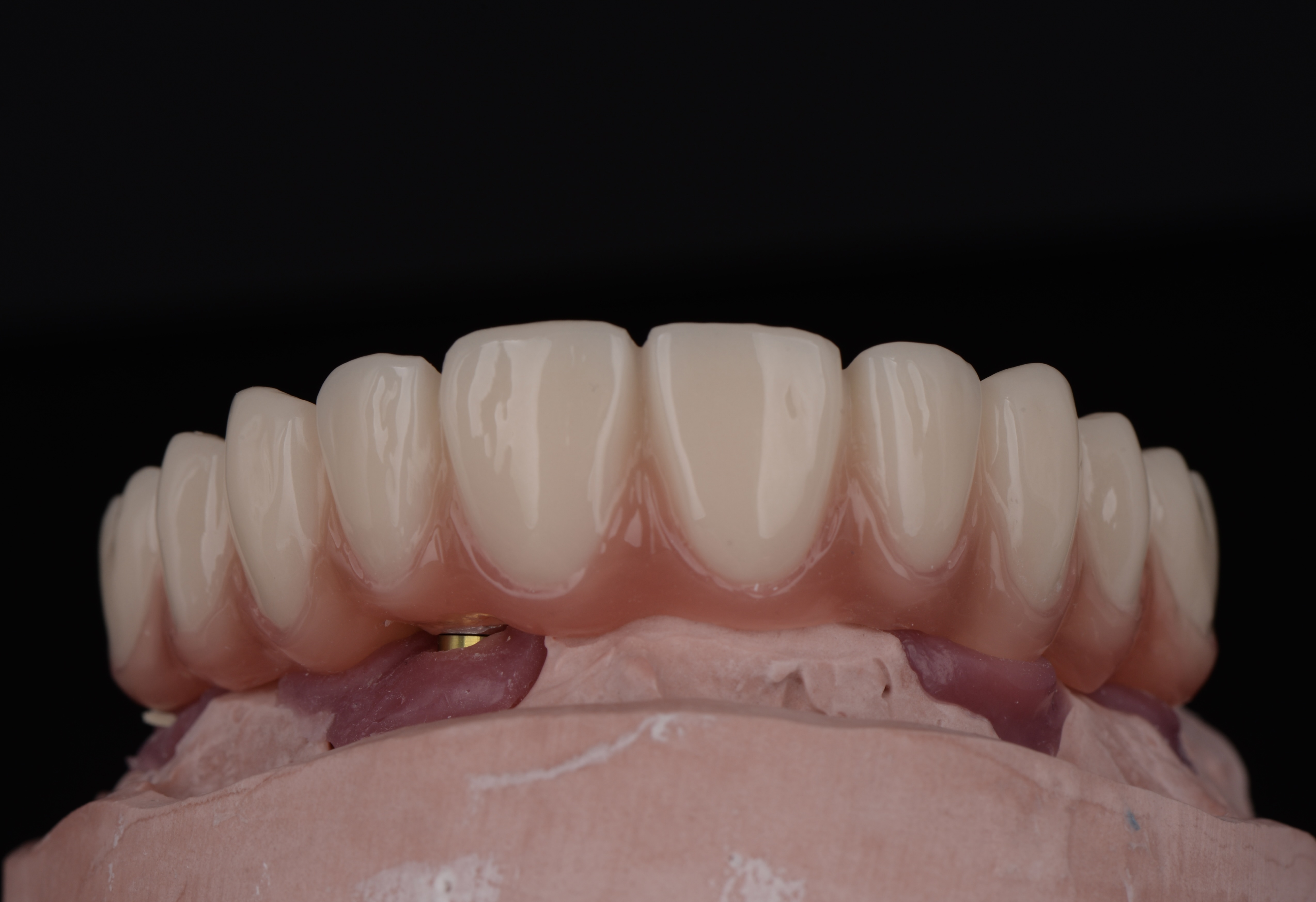
A prototype is a deliberate trial version of the proposed restoration. It allows me to evaluate the restoration in the patient's mouth before we commit to the definitive one.
Digital dentistry can provide remarkably accurate information, but every record still has to be acquired correctly.
Even with photogrammetry, for example, a reference component may not be completely seated or another acquisition error can occur. Bite records and other digital records also have to relate correctly to one another.
The prototype gives me an opportunity to verify the result clinically.
Does it seat as expected?
Does the bite we designed digitally reproduce correctly in the patient's mouth?
Do the upper and lower teeth meet where I intended them to?
If something does not correspond to the records or the design, I want to discover that now—not after the definitive restoration has been fabricated.
Once I know the records have translated appropriately, there is another question:
Is this actually the restoration we want?
The patient is not a computer model.
With the prototype in the mouth, I can evaluate the proposed tooth position in the face.
How much tooth shows when the lips are at rest?
How does the smile relate to the face?
Is the lip support appropriate?
Do the tooth length and proportions look right for this patient?
These decisions become much easier to evaluate when I can see the patient speaking and smiling rather than looking only at a digital design.
Changing an entire arch of teeth changes the environment around the tongue and lips.
Tooth position and restorative contours can influence speech. The restoration can also feel too bulky or occupy more tongue space than necessary.
Some initial adaptation after a major change is normal. But I don't want to assume that every concern will disappear with time if there is something about the design that can be improved.
The prototype gives us an opportunity to listen, evaluate, and modify.
The prototype also gives me clinical information that cannot be captured fully in a digital design.
A patient may report something while speaking, chewing, smiling, or simply living with the restoration that is difficult to appreciate during a digital design review.
I consider that feedback alongside tooth position, facial support, speech, bite, seating, contours, and hygiene access.
When a refinement is clinically appropriate, I incorporate it into the definitive design.
I don't consider the prototype an unnecessary intermediate step between digital design and the final restoration.
It is another diagnostic and verification step.
It helps me answer:
Did our records translate correctly?
Does the restoration seat as expected?
Is the bite where we designed it?
Does the design work with the patient's face, speech, and function?
And most importantly:
Is this the restoration we actually want?
I would rather answer those questions with a prototype than discover the answers after the definitive restoration is finished.
Results and treatment needs vary from patient to patient. This article is for educational purposes only and does not replace an individual clinical examination, diagnosis, or treatment recommendation.