What Is “Bite Collapse”? Signs, Realities, and Treatment

When teeth become severely worn, chipped, or missing, patients often encounter the phrase “bite collapse.”
The term can sound alarming. Patients may worry that their face has become shorter or that their jaw joints have been damaged.
“Bite collapse” is a descriptive term rather than a precise diagnosis. It commonly describes a bite that has lost adequate support from the back teeth, shifting more of the closing and chewing forces onto the front teeth. This can happen with or without a loss of bite height.
Understanding what has changed requires evaluating the remaining teeth, their supporting bone, and how the bite has adapted over time.
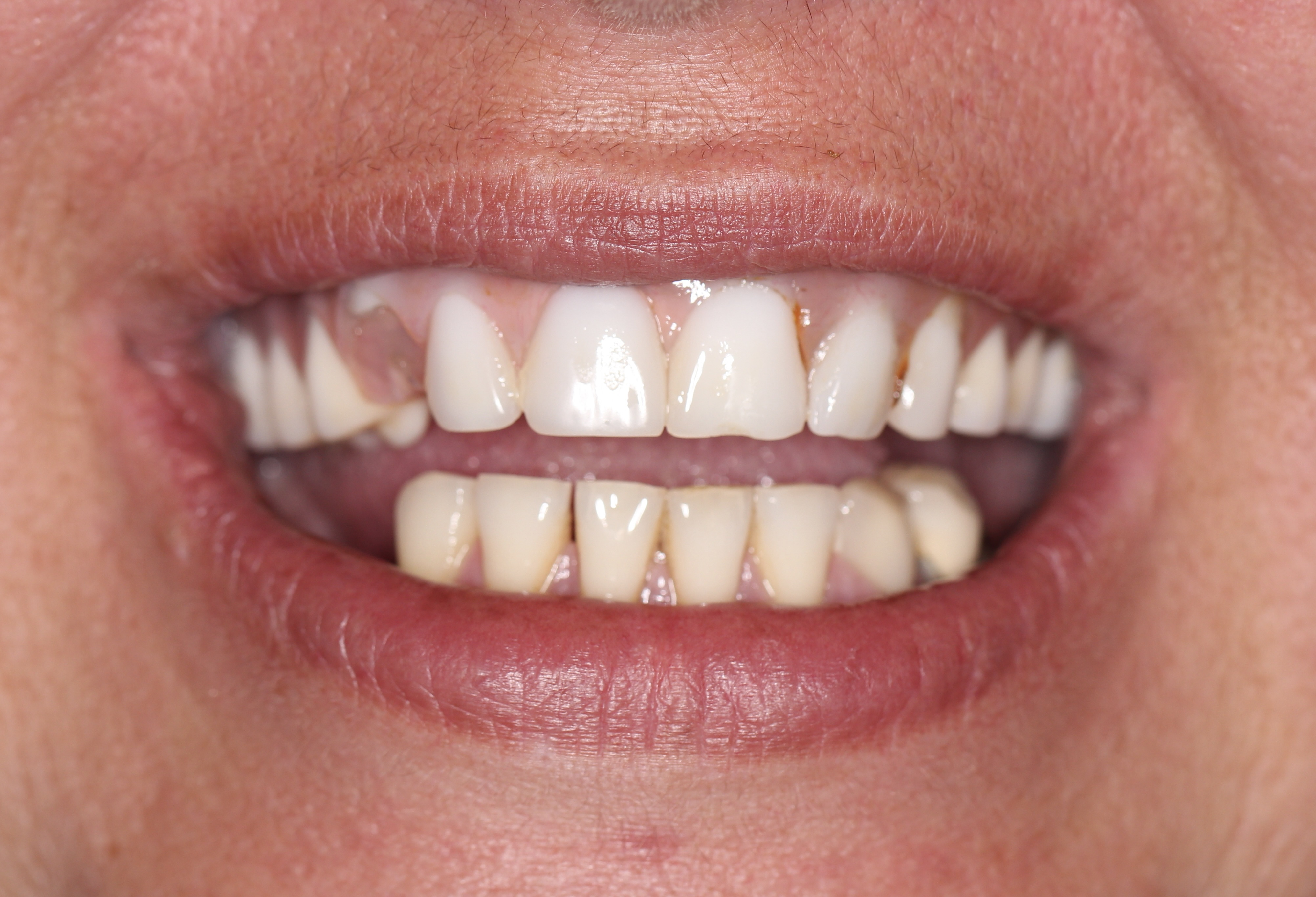
Patients may notice shorter or chipped front teeth, new spaces, upper teeth that have begun to flare, or a bite that seems deeper than before. Others describe difficulty finding a comfortable bite or jaw muscles that tire easily.
Changes may become noticeable in the front teeth even when a contributing problem lies farther back. However, these findings do not establish the cause. New spacing, flaring, or tooth movement also requires evaluation of the gums and bone supporting the teeth.
A common assumption is that as teeth wear down, the face must become shorter.
In many cases, the body compensates. As teeth wear gradually, continued eruption and adaptation of the surrounding bone can help maintain contact between the upper and lower teeth. This process is called dentoalveolar compensation.
A patient can therefore lose substantial tooth structure while maintaining much of the original bite height. The front teeth may look shorter, the biting surfaces may become flatter, and the way the teeth guide jaw movement may change without a corresponding reduction in facial height.
This adaptation creates a restorative challenge: the teeth have lost structure, but there may be little room to replace it.
The pattern and cause of wear matter as much as its severity.
Tooth wear can involve acid exposure from diet or reflux, mechanical wear from tooth contact, or a combination of factors. Grinding involves movement between contacting teeth, while clenching adds load. Wear alone does not establish whether a patient is currently grinding during sleep.
I assess these contributing factors alongside the tooth relationships. The way the teeth fit together influences where forces are carried, but it does not, by itself, explain why a patient clenches or grinds.
True loss of bite height, called loss of occlusal vertical dimension, can occur when tooth destruction or loss of support exceeds the mouth’s ability to adapt.
Possible contributors include extensive loss of back-tooth support, rapid destruction of tooth structure, or worn and fractured restorations or dentures that no longer maintain the previous tooth relationships.
The effect depends on what remains. The number, position, condition, and contact of the remaining teeth all matter.
There is no single measurement that establishes how much height has been lost. I evaluate tooth contacts, available restorative space, facial proportions, speech, and the space between the teeth when the jaw is at rest. Previous photographs, scans, or dental records can also help clarify what has changed.
The purpose is to distinguish actual loss of height from compensated wear, tooth movement, or another change in the bite.
Increasing bite height can serve different purposes. It may re-establish height that has been lost, or it may create space to restore worn teeth even when the existing height has been maintained.
These are different clinical situations. Increasing the bite during treatment does not prove that it was previously collapsed.
I plan the proposed change around tooth length, restorative space, speech, lip closure, and tooth contacts during closing and jaw movement. The amount of change must serve the reconstruction.
A change in bite height also does not automatically relieve jaw pain or treat a sleep disorder. Those concerns require their own assessment. When they are present alongside tooth wear or bite changes, the treatment goals must be clearly defined.
When treating extensive wear or a collapsed bite, I evaluate the relationship between both arches, the remaining tooth structure, and the space needed for restoration.
In my practice, rebuilding a collapsed bite often requires restoring at least one arch. It does not necessarily require restoring both.
I plan tooth length, shape, and bite together. Esthetics and function are designed simultaneously. The decision about which teeth to restore depends on their condition and their role in the proposed bite.
For example, a patient with substantial upper tooth wear and a collapsed bite may be treated by restoring the upper arch while retaining the existing lower teeth. Both arches are included in the planning, even though restorations are placed in only one.
Depending on tooth position and the available space, treatment may be restorative, orthodontic, or a combination. When teeth are missing, the plan also addresses how to re-establish appropriate support.
For complex reconstruction, I use diagnostic designs and, when indicated, prototypes or provisional restorations to evaluate the proposed tooth relationships before final restorations are fabricated.
This phase allows me to assess speech, chewing, comfort, tooth contacts, and appearance with the planned tooth form in place. Adjustments can be made as treatment progresses.
Long-term care then includes monitoring the teeth and restorations, managing contributing factors, and providing protection when indicated.
“Bite collapse” is the beginning of an evaluation, not a treatment plan. The important questions are what has changed, what support remains, and what needs to be rebuilt. Those findings determine whether treatment involves one arch, both arches, or another approach.
This article provides general educational information and does not replace an individual examination, diagnosis, or treatment plan. Treatment recommendations and outcomes vary according to each patient’s clinical circumstances.