Why I Adopted Photogrammetry Early for Full-Arch Implant Treatment
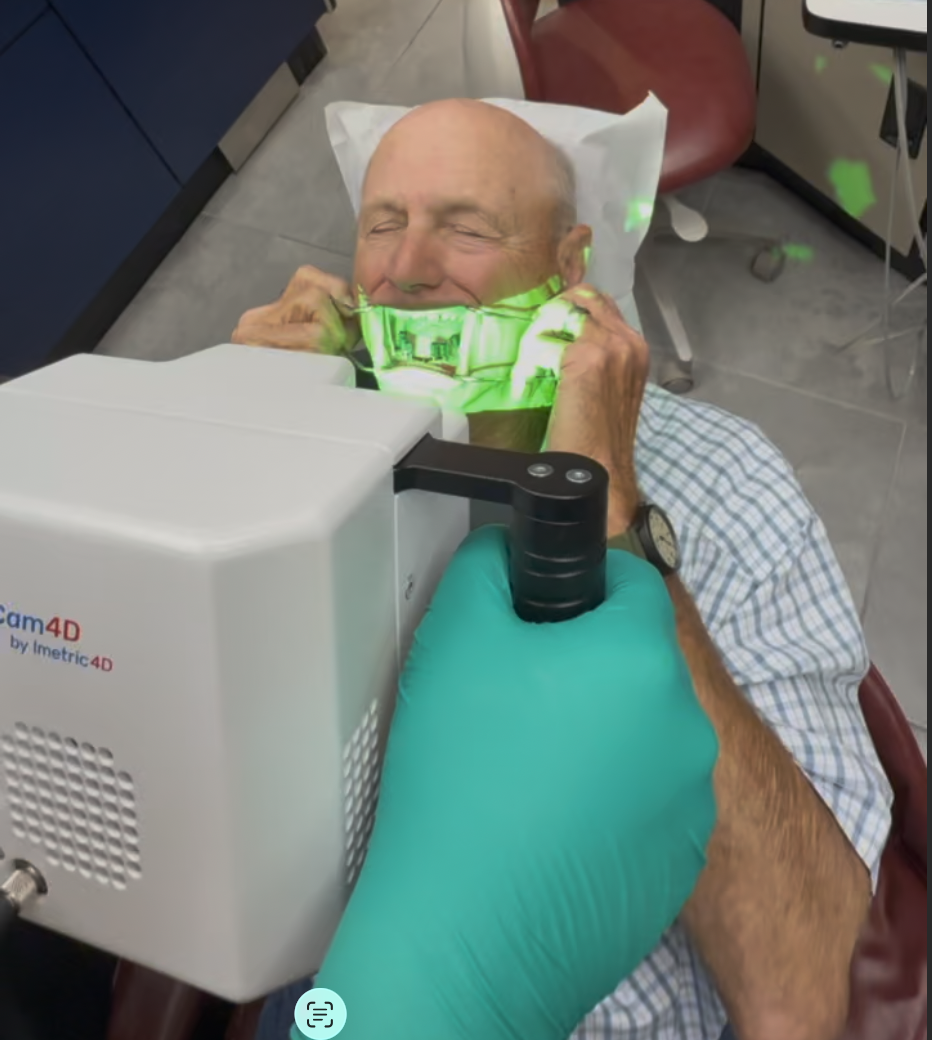
I had been practicing prosthodontics for nearly 20 years when iCam photogrammetry became available.
I was quick to adopt it because I knew exactly what problem it could solve.
When several implants support one full-arch restoration, we need an extremely accurate record of how those implants relate to one another. The implants are fixed in bone, and the restoration has to fit all of them at the same time.
For years, obtaining and verifying that information required multiple physical transfer steps, each introducing another opportunity for discrepancy.
Complete-arch implant records traditionally involved implant impression components, impression materials, stone models, and verification procedures.
We worked meticulously because small discrepancies during those transfers could affect the accuracy of the model used to fabricate the restoration.
A verification jig provided another opportunity to compare the model with the actual implant positions in the patient's mouth and correct discrepancies when necessary.
Even after careful impressions and verification, there was still that important moment when the definitive restoration was seated and I evaluated whether it truly fit passively.
By the time photogrammetry became available, I understood that problem very well.
Photogrammetry is best understood as an implant-position record, not a complete digital impression of the mouth.
With the iCam system I use, calibrated reference components are connected to the implants. Synchronized cameras capture those components from multiple views, allowing the system to calculate their three-dimensional position and angulation relative to one another.
In simple terms, it gives me a highly precise digital record of where the implants are.
That is its job.
I use intraoral scanning extensively, but an intraoral scanner and a dedicated extraoral photogrammetry system obtain information differently.
An intraoral scanner moves through the mouth, capturing images and progressively stitching them together to create a three-dimensional model. Across a longer span, small discrepancies may accumulate depending on the scanner, scan strategy, implant configuration, available reference geometry, and clinical conditions.
Photogrammetry does not determine the implant relationship by progressively stitching its way across the arch. It measures calibrated reference components from outside the mouth and calculates their spatial relationship.
That distinction matters to me in full-arch implant treatment.
A full-arch restoration may connect rigidly to several implants. The more accurately those implant positions are recorded, the more accurately we can design the restoration around their true relationship.
Ultimately, I want the restoration to seat accurately rather than depend on its screws to compensate for a discrepancy.
That concept is called passive fit, and it deserves its own discussion.
Photogrammetry does not create passive fit by itself. It gives me a more precise starting record from which to pursue it.
In my full-arch workflow, photogrammetry replaced several physical transfer steps I had spent years performing and verifying conventionally.
It does not design the teeth. It does not determine the bite, tooth position, esthetics, phonetics, or facial support.
It solves a narrower problem extremely well: it tells me where the implants are.
I adopted photogrammetry early because I had spent nearly 20 years managing the problem it was designed to solve.
Results and treatment needs vary from patient to patient. This article is for educational purposes only and does not replace an individual clinical examination, diagnosis, or treatment recommendation.