Why Passive Fit Matters in a Full-Arch Implant Restoration
When several implants support one full-arch restoration, I want the restoration to fit the implants—not the screws to force the restoration into place.
That distinction is at the heart of passive fit.
A full-arch restoration may connect rigidly to several implants.
Those implants are fixed in bone. If the framework does not accurately correspond to their positions, tightening the screws can draw the restoration toward the implants.
It may be possible to tighten a restoration into place.
That does not mean it fits passively.
In practical terms, passive fit means the framework seats accurately on the implants without using the screws to force a misfitting restoration into position.
Implant restorations function under repeated chewing forces and, in some patients, greater forces from clenching or grinding.
I don't want the prosthesis itself to introduce unnecessary strain before the patient even begins using it.
A discrepancy can change the mechanical environment of the restoration and its screws. Screw loosening, screw fracture, or other recurring mechanical complications may be signs that deserve investigation rather than repeated repair.
A misfit does not automatically mean an implant will fail. The relationship between framework discrepancy, mechanical complications, and long-term biological outcomes is more complicated than a single cause-and-effect rule.
But avoiding unnecessary strain remains an important prosthodontic objective.
With a single implant crown, we are restoring one implant.
A full-arch prosthesis may connect to several implants positioned across a much larger span.
That means the relationship among all of those implants must be accurately transferred to the restoration.
The implant-position record matters. The restorative components need to be correctly seated. The prosthesis has to be accurately manufactured. And the completed restoration still needs to be evaluated clinically.
No single technology creates passive fit by itself.
The prosthetic screws are designed to retain the restoration.
I do not want to use them as a method of correcting a framework that does not correspond accurately to the implants.
If a full-arch restoration does not seat as expected, I want to understand why.
Is there an error in the record? Is a component incompletely seated? Is there a discrepancy in the framework or manufacturing process? Is something interfering with seating?
The appropriate response depends on the cause.
Accurate implant-position capture is one part of pursuing passive fit.
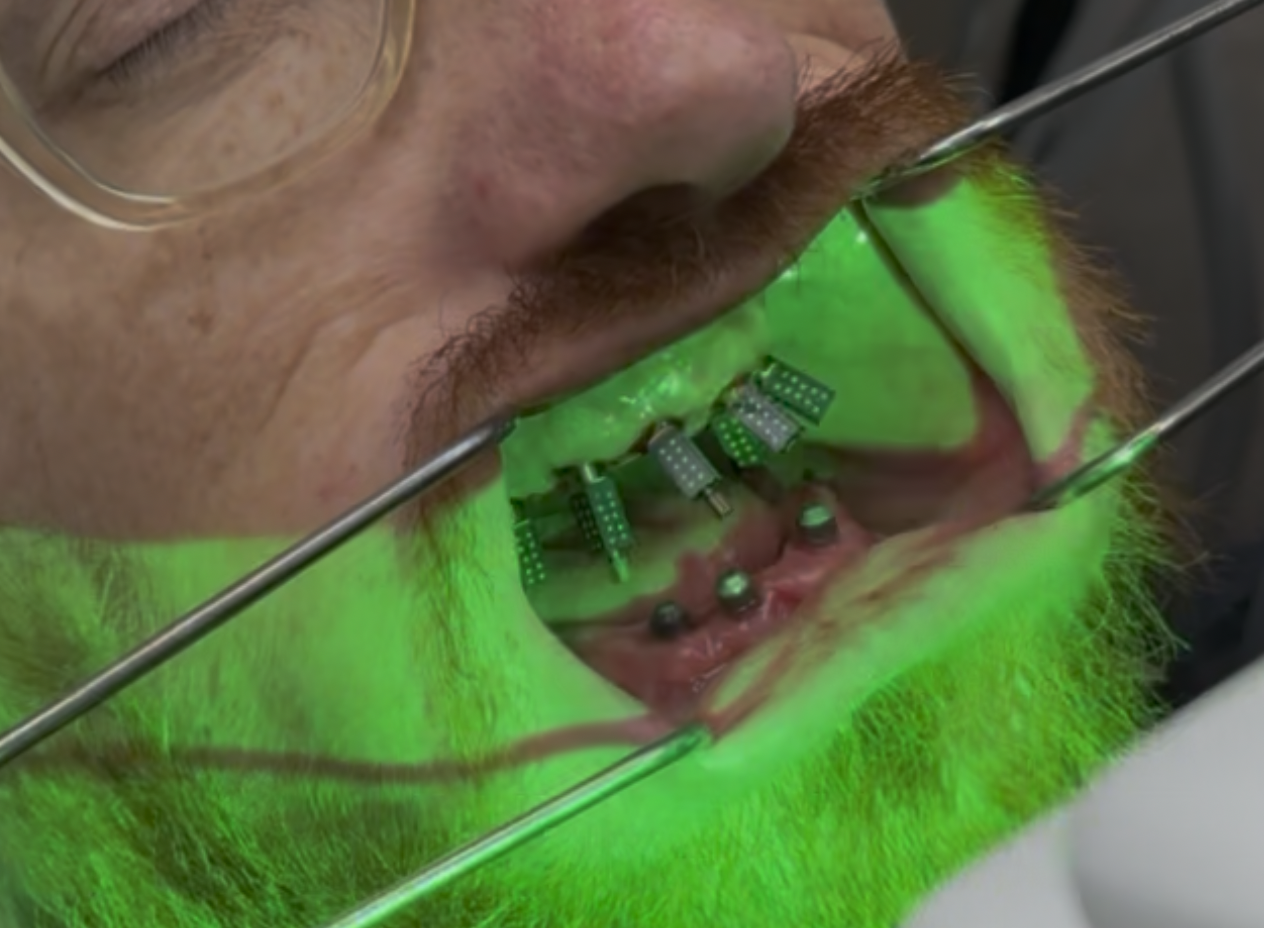
That is why I use photogrammetry in my full-arch workflow. It gives me a precise record of how multiple implants relate to one another before the restoration is fabricated.
It does not guarantee passive fit.
It removes one important source of uncertainty.
Results and treatment needs vary from patient to patient. This article is for educational purposes only and does not replace an individual clinical examination, diagnosis, or treatment recommendation.